

A free UK immigration record plan can be a simple system you create yourself, rather than an official form. If important documents are spread across email, paper files and devices, finding the right item or date can take time. A clear index brings the details together and helps you keep track of what you have, without replacing official immigration guidance.
You can start with tools you already use, such as a folder on your device, a spreadsheet or a paper index. This guide shows you what to record, how to keep information current and how to make documents easier to find. An organiser helps you manage personal records; it does not advise on immigration decisions or support an application.
Your personal record plan is separate from a UKVI account, which is used to view and prove immigration status where that status is held digitally. A Home Office Subject Access Request may help you access historical information held about you. Neither is a replacement for your own organised record of documents and dates. The aim here is steady record-keeping, with official sources for questions that go beyond administration.
Key Takeaways
- Start a free UK immigration record plan with a spreadsheet, paper index or folders you already use.
- Use a simple five-step process to list relevant records, note where they’re stored and keep key details up to date.
- Compare paper, spreadsheet and digital options to choose a system that suits how you access and update your records.
- Keep personal organisation separate from immigration decisions, and follow current GOV.UK guidance for your route.
- If you want a more structured digital system, REKODHA can help catalogue, store and organise personal documents and timelines.
What Is a Free UK Immigration Record Plan?
A free UK immigration record plan is a personal system for listing immigration-related records, noting where they’re kept and updating those details when things change. It isn’t a government document. Start with a spreadsheet, paper index or folders you already use, then organise it around your own circumstances.
The purpose is to make your information easier to locate. An index entry might show a document’s name, the date it relates to, where you saved it and whether you plan to review it. The index is not the document itself: it describes what you hold and where to find it, but it doesn’t replace or recreate the evidence.
A record plan supports administration, not immigration decisions. It isn’t an official form, a route-specific checklist or a way to establish eligibility. UK immigration rules and processes can vary by route. A broad overview of the Immigration policy of the United Kingdom can provide background, but it isn’t a substitute for current instructions for your circumstances.
What Does a Personal Record Plan Help You Do?
A useful plan gives you one place to check what you have and where it is. For example, you can note whether a record is in a paper folder, an email attachment or a named folder on a device. Add dates or short descriptions when they help you tell similar items apart. This makes it easier to find records and spot entries that need updating.
Keep the index focused on locating and tracking records, not judging their legal value. “Saved in email, received in March” is a location and a detail you can verify. It doesn’t say whether the item is required or sufficient for an application.
Update the plan when your circumstances change, new records arrive or you move files to a different folder. A brief review on a routine that works for you can keep the index useful without making record-keeping a major task.
What a Free Plan Cannot Replace
A personal plan isn’t a Home Office checklist or application form. It can’t determine whether you’re eligible for a route, confirm which evidence you need or predict how a decision will be made. Even an index that looks complete only reflects the information you’ve recorded. It doesn’t confirm that your records meet an official requirement.
For route-specific requirements, follow the current GOV.UK guidance and instructions relevant to your situation. Use your plan to track documents and dates, then compare your preparation with those official instructions when needed. If guidance changes, update your personal notes. Your plan helps organise records; official sources explain the process and requirements.
How to Build a Free UK Immigration Record Plan, Step by Step
A free UK immigration record plan can be simple and personal. You don’t need to catalogue every paper or use a particular format. Start with the records you want to track, then create an index that makes them easier to find and review. You can follow the five steps below in a spreadsheet or paper notebook.
Choose a Simple Format and Create an Index
Choose a spreadsheet if you want searchable rows, a notebook if you prefer a paper record, or digital folders if those already work for you. Use categories that suit your circumstances, such as identity, correspondence or a personal timeline. Make the index point to where records are stored, rather than copying sensitive details into it unnecessarily.
Add Dates, Locations and Review Notes
Include dates that help you understand the sequence of events, such as when a record arrived or a personal milestone took place. These are organisational notes, not a statement that a particular date or document is an official requirement. If a record is replaced or moved, update its entry and set a review reminder that fits your routine.
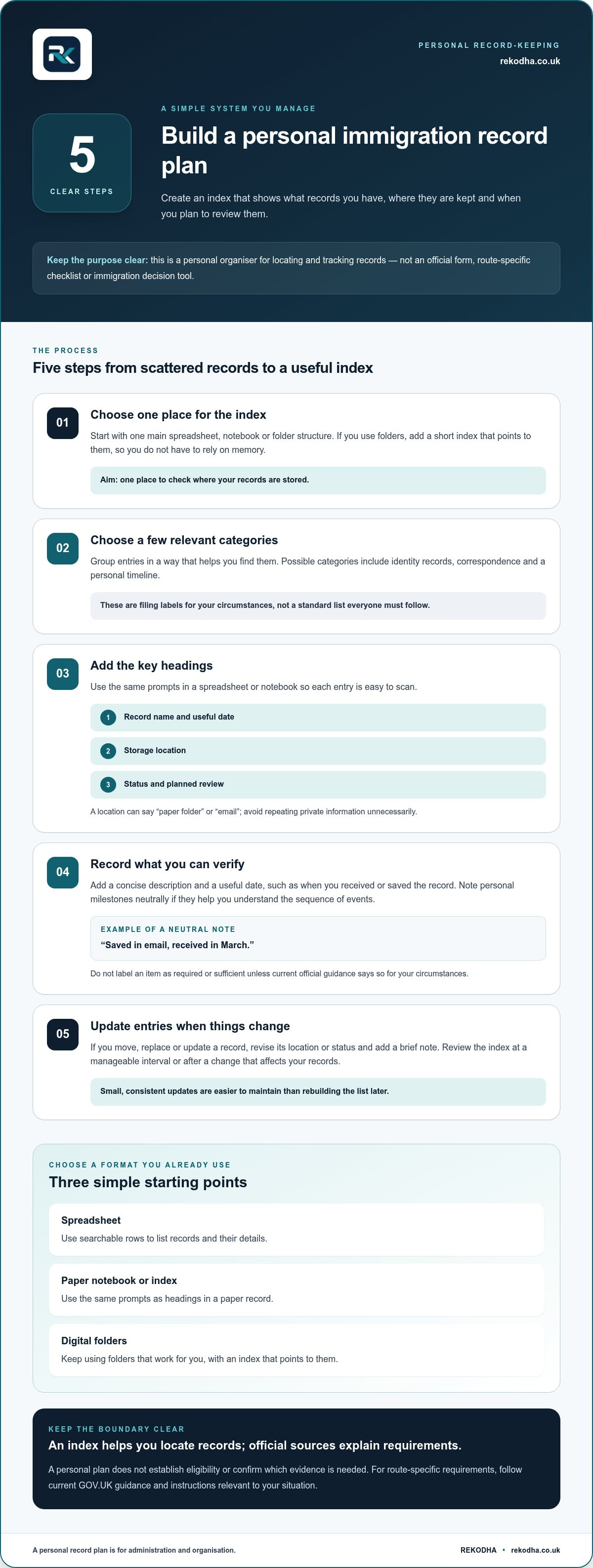
A useful personal index names each record, shows where it is and gives you a way to track its status and review it. Put that into practice with these steps:
- Choose a place to keep the index. Use one main spreadsheet, notebook or folder structure as your starting point. If you use folders, create a short index document or paper list that points to them, so you don’t have to rely on memory.
- Decide on a few relevant categories. Group entries in a way that helps you find them. For example, you might separate identity records, correspondence and a personal timeline if those categories suit your situation. These are filing labels, not a standard list everyone must follow.
- Add the key columns or headings. For each entry, note the record name, its date, where it is stored, its status and when you plan to review it. In a notebook, use the same prompts as headings. A location might say “paper folder” or “email”, rather than repeating private information in the index.
- Record what you can verify. Add a concise description and a useful date, such as when you saved or received the record. If a personal milestone helps you understand the order of events, note it in neutral terms. Don’t label an item as required or sufficient unless current official guidance says so for your circumstances.
- Update the entry when things change. If you move, replace or update a record, revise its location or status and add a brief note. Review the index at a manageable interval or after a change that affects your records. Small, consistent updates are easier to maintain than rebuilding the list later.
If keeping a digital index and timeline across different folders becomes difficult, REKODHA’s digital record management system provides a more structured way to catalogue and organise personal records.
Free Spreadsheet, Paper File or Digital Organiser: Which Plan Fits?
The right format is the one you can access and keep up to date. A free spreadsheet or paper plan can be a practical starting point, especially when your records are limited and easy to locate. A digital organiser may suit you if you want to catalogue documents and timelines in a more structured system. No single option fits every person or set of circumstances.
Compare the formats by considering three everyday needs: how you’ll access the information, how quickly you can find an entry and how easily you can update it. Think about privacy too. Immigration-related records may contain sensitive personal information, so consider who can access your chosen storage and whether that arrangement suits you.
When a Paper or Spreadsheet Plan May Be Enough
A short index can be enough to manage a small, consistent set of records. Paper is easy to consult without opening a device, but searching and changing entries may take longer. A spreadsheet is searchable and simple to edit, although you need access to the device or location where you saved it. Either option can work well if you have a routine for keeping it current.
Use clear folder names alongside the index, such as “Correspondence” or “Personal timeline”, if those categories suit you. Consistent file names also make electronic folders easier to scan. For example, adding a brief record description and date can help you distinguish similar items. If appropriate for your circumstances, keep a separate backup of the index and records, and store it with privacy in mind.
When a Digital Record Tool May Be More Practical
If records and dates are spread across several places, a structured digital system can make catalogue entries and timelines easier to manage together. REKODHA helps people catalogue, store and organise personal documents and timelines, and supports long-term record tracking. It is an administrative option, not a requirement for building a useful plan.
Use this comparison to weigh the trade-offs:
- Paper index and file: You can consult it without a device, but searching, changing entries and keeping it accessible in more than one place may take extra effort.
- Spreadsheet with folders: You can sort or search entries and point each row to a file location. Updates are straightforward, but you’ll need to remember where the spreadsheet is saved and keep folder names consistent.
- Digital organiser: A structured tool can bring catalogue details and timelines into one digital system. Its value depends on whether that arrangement suits how you access and maintain your records.
Start with what you already have. If a notebook or spreadsheet stays clear and current, there may be no reason to change it. If you’re duplicating lists or losing track of storage locations, consider whether a more structured format would make ongoing organisation easier. The best free UK immigration record plan is one you can maintain while handling your documents with care.
Use Your Record Plan Carefully: Official Guidance, Privacy and Boundaries
A free UK immigration record plan can bring your personal records into order, but it can’t establish that you’re eligible for an immigration route or guarantee a decision. Treat it as an administrative aid, not a source of immigration instructions. Current guidance for your circumstances explains the requirements that apply to your route.
Organising evidence helps you keep track of what you hold; it doesn’t decide what evidence an application requires. An index can look complete without showing whether a record is relevant, sufficient or required. Keep your notes separate from official instructions, and refer to GOV.UK for route-specific information.
Keep Official Requirements Separate from Your Personal Index
Label your notes clearly, for example “personal record index” or “my timeline”, so they aren’t mistaken for Home Office guidance. Use GOV.UK and current information from UK Visas and Immigration (UKVI) for instructions that apply to your route. If you note a requirement for your own reference, record where and when you checked it, then revisit the official source before relying on that note.
Categories such as identity, correspondence or travel history can help you organise a personal file, but they’re examples, not a universal evidence list. Your circumstances and route determine which instructions are relevant. Don’t treat a category in your index as proof that a document must be submitted.
Your own records are also distinct from information held by the Home Office. A Subject Access Request may help you access personal information the department holds, including historical information. It is separate from your personal index and does not establish what evidence a particular application requires.
Handle Sensitive Records with Care
Identity and immigration status records can contain personal details. Think about who needs access to your files, and avoid sharing the entire record set when a narrower item or detail will do. Choose storage that fits your circumstances, and take care with shared devices, email accounts or paper folders that other people can access.
Clear file names make records easier to retrieve, but they don’t need to reveal sensitive information. A neutral label and date may be enough to distinguish an item. Avoid putting unnecessary identity numbers or private details in a file name. If you keep copies in more than one place, note where they are so you can review duplicates periodically. Retain or remove copies according to your needs and any applicable guidance.
These boundaries apply whether you use a paper list, spreadsheet or digital organiser. Keep the index factual: record where an item is, when it was added or updated, and when you plan to review it. If an official instruction changes, update your personal notes rather than treating an old entry as current. This keeps your organisation useful without confusing personal tracking with immigration advice or a decision.
If you’d like a structured way to catalogue, store and track personal documents and timelines, explore REKODHA’s digital record management. It supports administration, while route-specific instructions remain a matter for current official guidance.
Switching from Free Plan to REKODHA Record Management
A free UK immigration record plan is a practical starting point. As records, dates and personal milestones build up, a simple index may take more effort to maintain. Moving to a structured digital system is optional. Consider whether your current arrangement still helps you find and update information without unnecessary effort.
You don’t need to start again when you change formats. Your existing index shows what you’ve recorded, where items are stored and which entries need attention. Use it as a reference while deciding whether a more structured digital approach would suit your ongoing record-keeping.
Signs Your Free Plan Has Become Difficult to Maintain
A few practical signals may suggest it’s time to review your system. Records might be spread between paper folders, email and device storage, with no clear index showing where each item belongs. You may find yourself updating several lists or forgetting whether a document has been moved, replaced or added to your timeline.
These are reasons to consider a more structured way to organise records, not signs that you’ve done anything wrong. An informal plan can still be useful, and changing your filing system does not determine an immigration outcome. Look for an approach that makes routine tasks easier: locating a record, noting a date and keeping a timeline current.
Before changing tools, review your entries. Mark which locations are still accurate, identify duplicate index entries and note any gaps in your own tracking. This gives you a clearer starting point and helps you carry forward the information you use, rather than transferring clutter without reviewing it.
What REKODHA Does, and Does Not, Support
REKODHA is a digital administrative system for organising personal records. It helps users catalogue, store and organise documents and timelines, with support for long-term record tracking. This structure can help you maintain a continuing record of personal documents and events in one system.
REKODHA’s role is administrative. It does not provide immigration legal advice, prepare or submit applications, or represent you. It does not decide which documents an application requires or whether you meet the criteria for an immigration route. For those questions, follow current GOV.UK instructions for your circumstances. A digital organiser can support your record-keeping, but it cannot replace official guidance or professional advice where needed.
If your current index is becoming difficult to maintain, explore REKODHA’s digital record management as a structured way to organise personal documents and timelines. Keep official route instructions separate from your personal records.
Make Your Records Easier to Carry Forward
Your records can change as your circumstances do. Revisit your system when something important changes, so it remains useful rather than becoming another folder to maintain. A free UK immigration record plan is a practical beginning, and you can adapt it as your needs or preferred way of working shift.
If you’d prefer a more structured digital approach, REKODHA helps you catalogue and organise personal documents and timelines, with long-term record tracking. It supports administration only; it doesn’t provide legal advice, prepare or submit applications, or represent you.
Explore REKODHA’s digital record management to organise your personal documents and timelines in a structured system. Keep your index factual, review it when records change and use current official guidance for route-specific requirements.
Frequently Asked Questions
Is a free UK immigration record plan an official Home Office document?
No. A free UK immigration record plan is a personal way to keep track of your records, not an official Home Office form or checklist. For example, an index can help you find a letter saved in an email account, but it can’t confirm whether that letter is required for an application. Follow current GOV.UK instructions for your route, and seek professional advice where your circumstances call for it.
Can I create an immigration record plan without paid software?
Yes. You can start without paid software by listing record names, dates and storage locations in a spreadsheet or notebook, then using clearly named folders to find the items themselves. For instance, an entry could point to a folder on your device without copying private details into the index. REKODHA is an optional digital administrative tool, and its record-management service is not described here as free.
What records should I include in a UK immigration record plan?
Choose categories that reflect your circumstances and route, rather than treating a sample list as a standard checklist. You might track identity records, correspondence or notes about personal milestones, if relevant. A practical entry can record where an item is and when you last updated its location. Check current official instructions to find out what evidence your particular route requires; an index alone can’t establish that.
How often should I update my immigration record plan?
Update the index when you add, replace or move an item, or when a personal milestone makes a new entry useful. You could also choose a regular review point that fits your routine, such as checking whether file locations are still accurate. This is an organisational suggestion, not an official timetable. Keep route-specific deadlines separate and verify them against current official guidance.
Does keeping an organised immigration record plan guarantee a visa or settlement outcome?
No. An organised plan can help you locate your records, but it doesn’t determine eligibility or influence a decision by itself. Outcomes depend on the relevant route and the requirements that apply to your circumstances. Use your index to manage personal information, not to predict a result. For route instructions, rely on current official guidance rather than assumptions based on how complete your file looks.
Can REKODHA submit a visa application or give immigration advice?
No. REKODHA provides digital record management and administrative preparation support. It can help organise personal documents and timelines, but it doesn’t provide immigration legal advice, prepare or submit visa applications, or represent users. Use current official guidance for process requirements, and obtain separate advice if you need help interpreting your circumstances. Keeping records in order is distinct from deciding what to apply for or taking action on an application.